Wintergate · a vault only you can open
The quantum-resistant vault for on-chain assets.
One vault, deployed on five chains today, built to go wherever assets live next.
Two keys made on your device: the one you use every day, and a one-time hash key no known quantum attack can forge. A stolen key alone opens nothing.
Same contracts, same addresseson five chains
- EthereumApp opens here first
- Robinhood ChainDeployed · verified
- HyperEVMDeployed · verified
- BaseDeployed · verified
- BNB ChainDeployed · verified
- ElysiumPlanned · 9 November
The app opens on Ethereum first, free to start. More chains open in the app after the final audit. Check the addresses
One protocol. The same address on every chain.
The same contracts, built from the same source, sit at the same addresses on Ethereum, Robinhood Chain, HyperEVM, Base and BNB Chain. Copy an address once and check it on any of them. Nothing in them can be changed: no admin key, no pause, no upgrade. Internal reviews and tests so far, no independent audit yet. Start small.
Ethereum mainnetLive since 13 Oct 2026 · the app opens here firstRobinhood ChainDeployed · source verified · the app opens here after the final auditHyperEVMDeployed · source verified · the app opens here after the final auditBaseDeployed · source verified · the app opens here after the final auditBNB ChainDeployed · source verified · the app opens here after the final audit
- Vault factory
0x860a…5911Creates your vault. Charges nothing itself.Etherscan - Vault code
0x45c7…0f31The rules every vault follows. Cannot be changed.Etherscan - Fee policy
0x15EF…ff72The vaults' fee setting: no fee. Your vault contract charges nothing.Etherscan - Quantum alarm
0xc902…6ed5Fires on a signature for a key nobody holds.Etherscan - Commit log
0x5b17…3451Records each move before the one-time key signs.Etherscan - Zap
0xD879…aaFfNot used by the app.Etherscan
- Ethereum mainnetThe first chainLive
- Robinhood ChainRollup on Arbitrum technology · source verifiedDeployed
- HyperEVMHyperliquid's own EVM chain · source verifiedDeployed
- BaseRollup on the OP Stack · source verifiedDeployed
- BNB ChainIts own chain (an L1) · source verifiedDeployed
Planned: Arbitrum One; Elysium, at its mainnet launch, announced for 9 November. Each chain opens in the app only when its own checks are done; no dates. Logos belong to their owners and only name the chains; no partnership is implied. Chains, the whole picture
Sending reveals your key. Check in a second.
Your address is not your key. It is a mask made from your public key, and the mask comes off the first time you send: the network has to see the key itself to accept the send, and it stays on chain for good. That key is what a quantum computer needs.
Your browser asks a public Ethereum endpoint directly. No sign-in, no wallet connection, nothing stored. It reads Ethereum mainnet; your address and key are the same on every chain here, so a send on any of them reveals it too.
The ice is thinner than it looks.
Nobody can date the first machine that breaks a wallet key. What can be tracked is the published cost of doing it, and it keeps falling.
- < 500,000
- physical qubits to break the curve behind every Ethereum key, and every wallet key on the other chains here, which use the same curve. About ten times fewer than the previous best estimate. Google Quantum AI with the Ethereum Foundation and Stanford, Mar 2026 [1]
- About 18
- minutes per key once such a machine exists, or 9 with precomputation. Summaries of the paper [1] [2]
- 2035
- the year NIST disallows today's signature algorithms. Deprecation starts after 2030. NIST IR 8547 [5]
Three things hold when the ice cracks.
Your vault is a contract nobody can change, the same code on every chain: no admin key, no pause button, no upgrade.

Two keys on every move
Your everyday key and a one-time hash key, both made on your device. A thief, or a quantum computer, with one of them gets nothing.

A 30-day brake
Lose everything and the emergency key you keep on paper starts a recovery. It waits 30 days, and only you can cancel it.

A door that is always open
Move everything out to your safe address at any time. No fee, nobody's permission, and it works without this site.
On Ethereum a move out takes about 10 minutes, on purpose: the chain records exactly what your one-time key may sign before your device signs it, so each one-time key signs once. How it works, in depth
When something goes wrong, there is a button for it.
One app, on your computer and your phone. It shows how protected you are, sends on purpose, and keeps three emergency doors in plain sight: key stolen, lost everything, site gone.
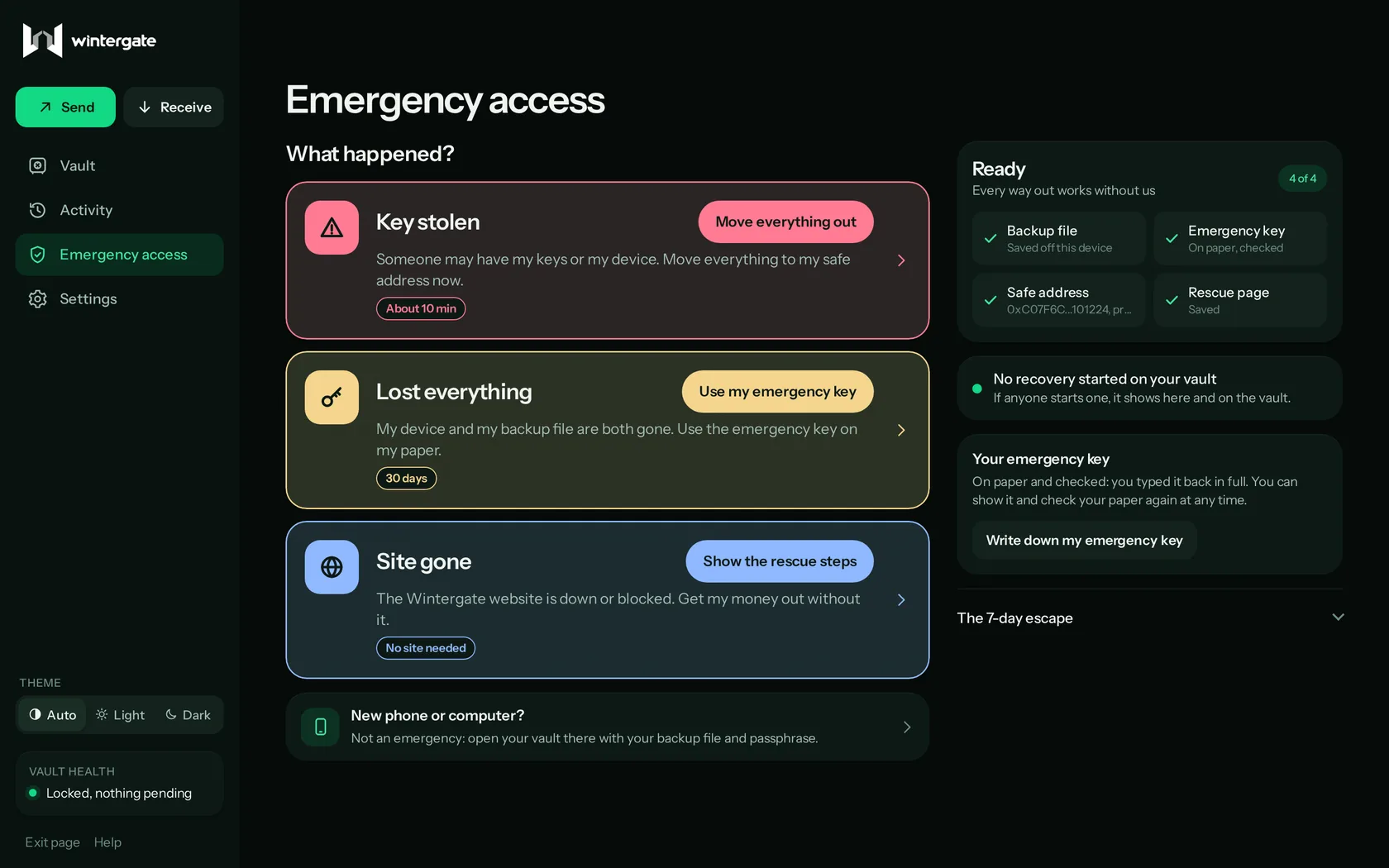
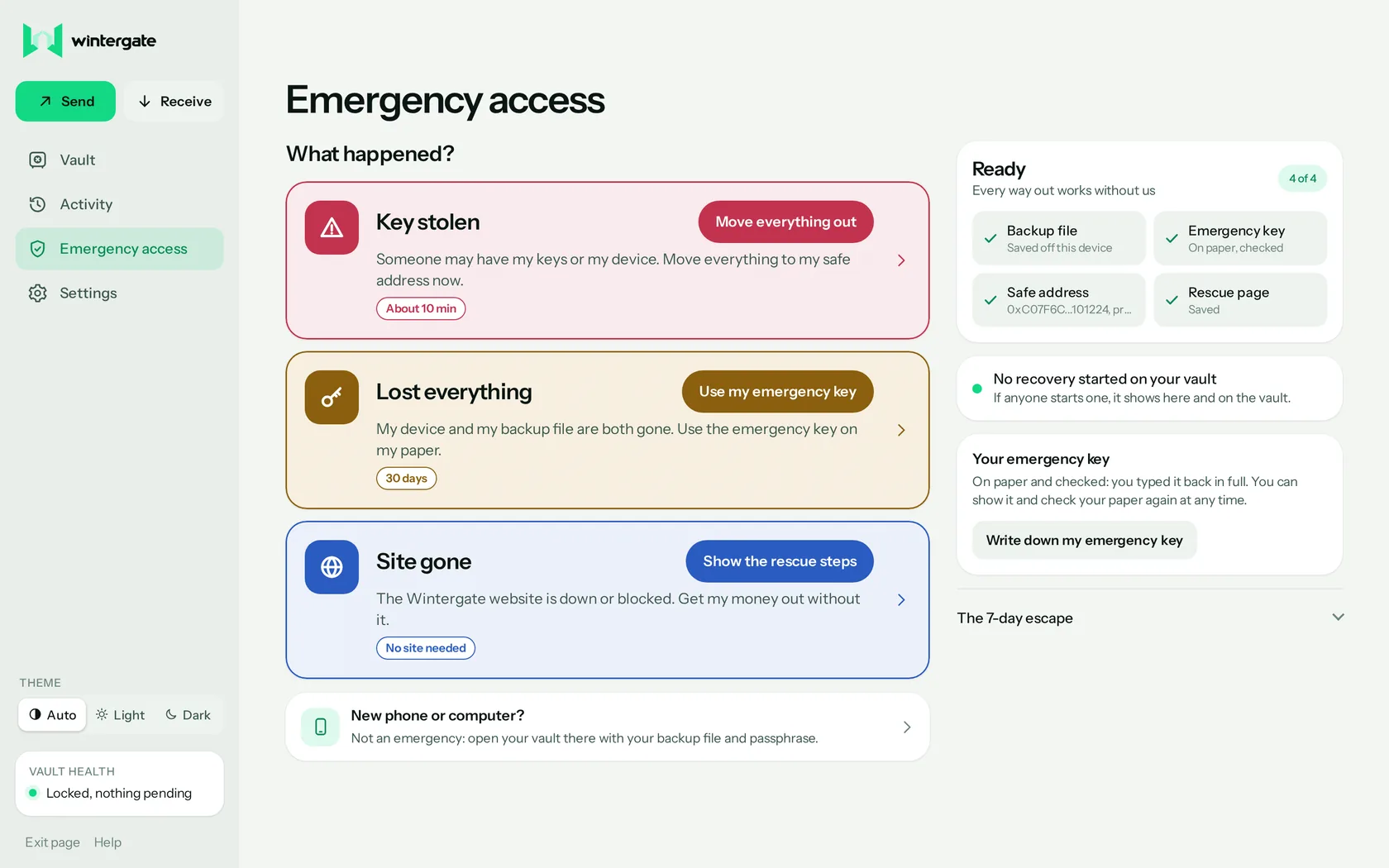
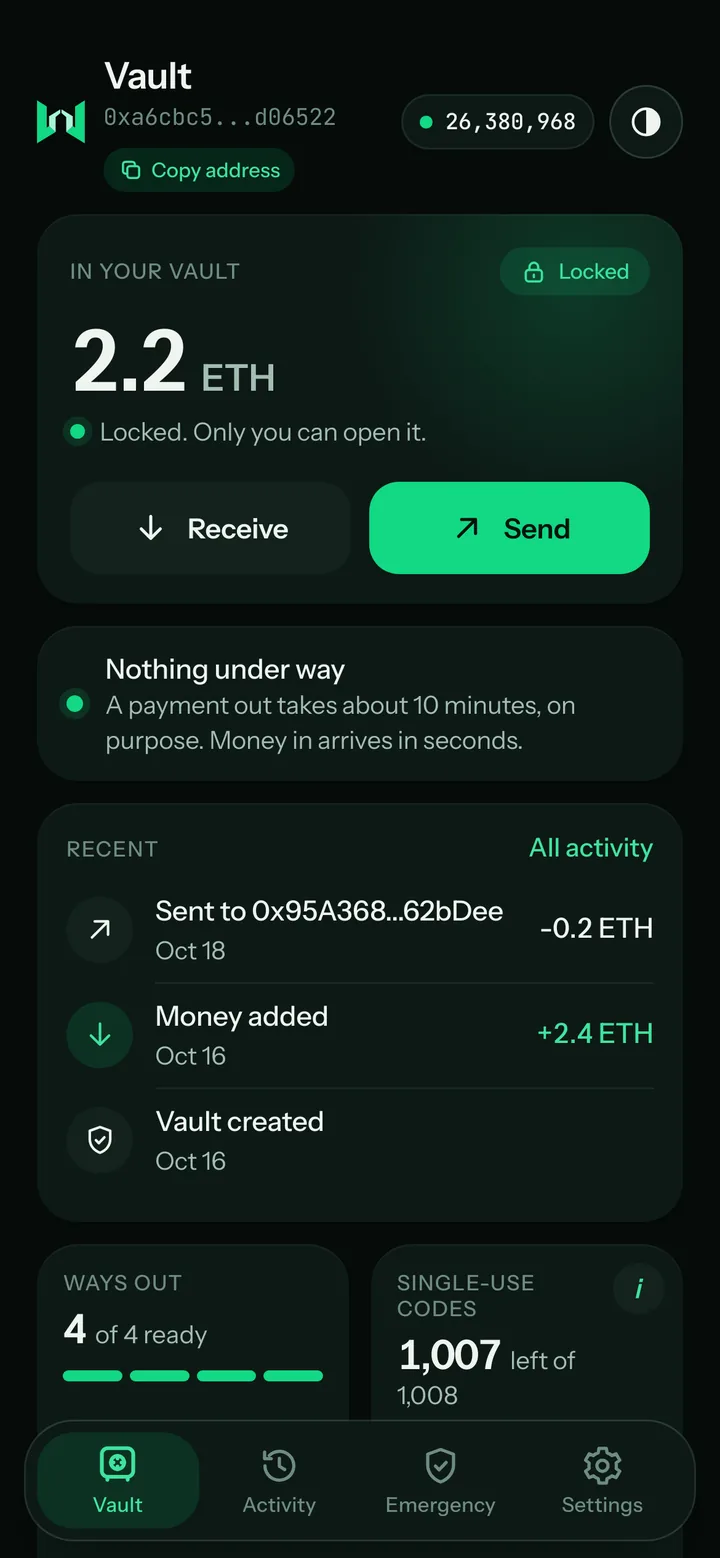
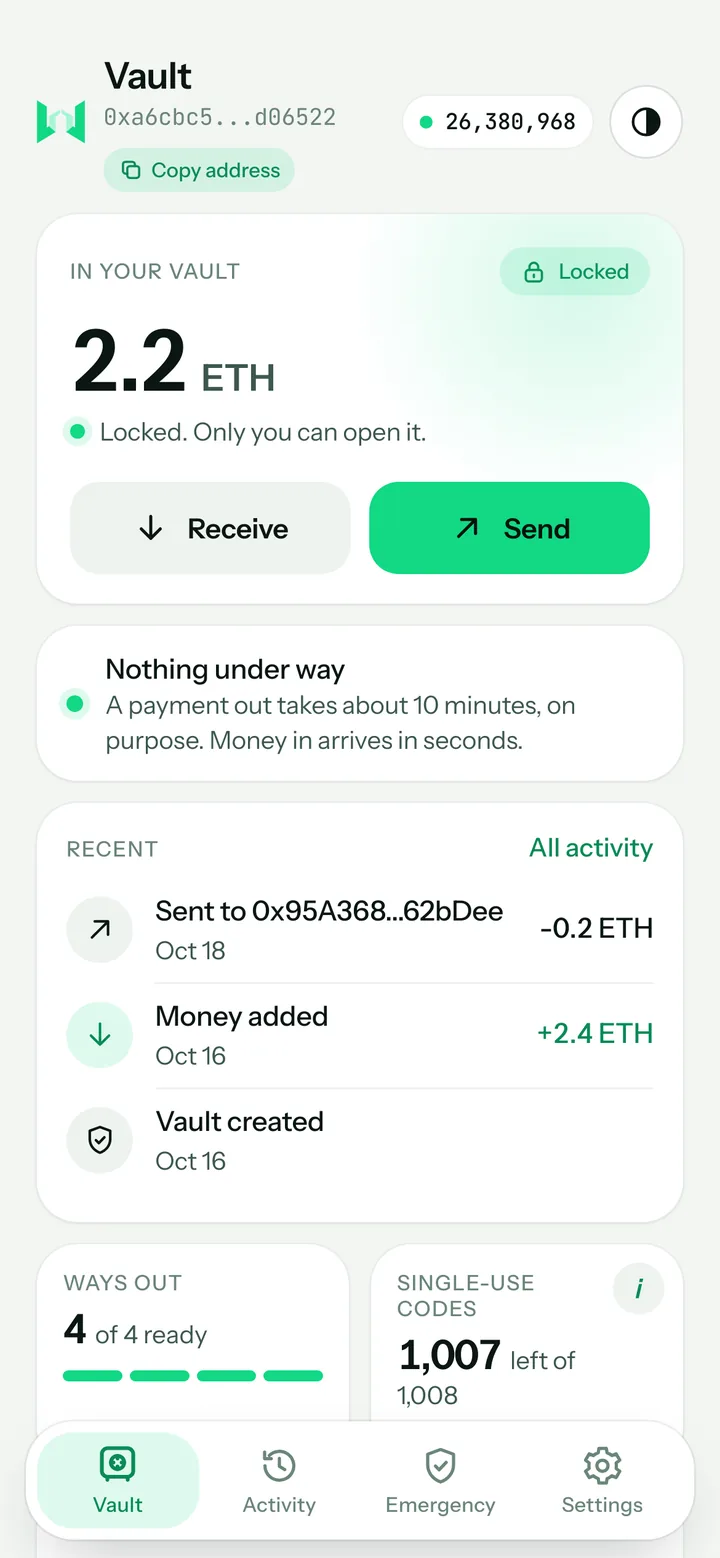
The real app with example data and pretend money. It opens soon.
Pick what goes wrong. Watch what holds.
Six things people fear, and which protection answers each one.
If a quantum computer works out your everyday key
- Passphraselocks keys on your devicenot involved
- Everyday keymade on your devicenot involved
- Hash keyone-time, quantum-resistantnot involved
- 30-day brakeon any recoverynot involved
- No admin keyno pause, no upgradenot involved
Holds.
The everyday key alone moves nothing. The hash key never left your device, and hash signatures are believed to resist quantum computers.
What you do Nothing urgent. For a clean start, move everything to your safe address.
Your funds stay put
What you keep
- Custody. Only your keys can move your funds. Lose every key and the backup, and nobody can help: that is the price of no admin.
- An exit any time, without a fee. Gas only.
- A 30-day recovery brake only you can pull.
What nobody can do
- Touch or block your vault. No server sits in the path of any move, exit or recovery.
- Change the rules. No admin key, no pause button, no upgrade.
- Make your vault charge you. Exits never pay a fee.
What you still trust
- Your device. Keys are made there. Keep it clean.
- The chain your vault is on.
- Our code. Internal reviews and tests, no independent audit yet. Start small.
Example scenarios. Nothing here connects to a wallet. The risks that remain, plainly
Small fees, in each chain’s own coin. Half of them feed the canary.
Not switched on yet: the app opens free, and setting up a vault and every move cost gas only. Fees are announced before they start, and the app takes them in the chain's own coin inside the move. Your vault contract never charges.
- $10
- once, to set up a vault, on every chain
- $1
- per move out on Ethereum, $0.10 on other chains, plus gas
- $0
- to leave or recover. Ever.
Not live yet
Fees are paid in the chain's own coin, and half of every fee buys back and burns WINTER. You never need WINTER in your vault, and your vault contract charges nothing. Any other token sold as WINTER is not the real one.
address shown here once it launchesThe canary
A real vault, its everyday key published. Take it if you can.
Half of every fee fills it, up to 40 ETH on Ethereum. Anyone who gets past the rest of the protection keeps what is inside: our standing open challenge. It is created when fees switch on.

Questions people ask first.
Short answers. The help pages go further.
All short answers Help and guidesWhat does quantum-resistant mean here?
Every move out of your vault needs a second signature from a one-time hash key made on your device. Hash-based signatures are believed to stay secure against quantum computers, unlike the curve behind every ordinary wallet key on these chains. It covers who can move your vault. It does not cover your device, the chain itself, or funds you keep outside the vault.
What if wintergate.tech disappears?
Your vault lives on its chain, not on this site. The rescue page is one file you save with your backup file: it talks to the chain through public endpoints and lets you move everything out. Leaving never charges a fee and never asks anyone.
Can anyone freeze, change or take my vault?
No owner, no admin key, no pause button, no upgrade. Your vault contract charges no fee and nobody can make it: fees are taken by the app, and leaving never pays.
How long does a move out take?
On Ethereum, about 10 minutes, on purpose. The chain first records exactly what your one-time key may sign, then waits until that record is safe. Only then does your device sign. Receiving takes seconds.
What if I lose my phone and my backup file?
Use the emergency key you wrote on paper. It starts a 30-day recovery. Any device that still holds your vault sees it and can cancel, so nobody can take over quietly.
Which chains does it cover?
One protocol, the same contracts at the same addresses: Ethereum mainnet, Robinhood Chain, HyperEVM, Base and BNB Chain. Ethereum is where the app opens first; on the others the contracts are deployed and source verified, and the app opens there after the final audit, each chain only once its own checks are done. Planned: Arbitrum One; Elysium, at its mainnet launch, announced for 9 November. There are no dates for the other chains yet.

Winter has arrived.
Protect what you keep before its key is exposed.